
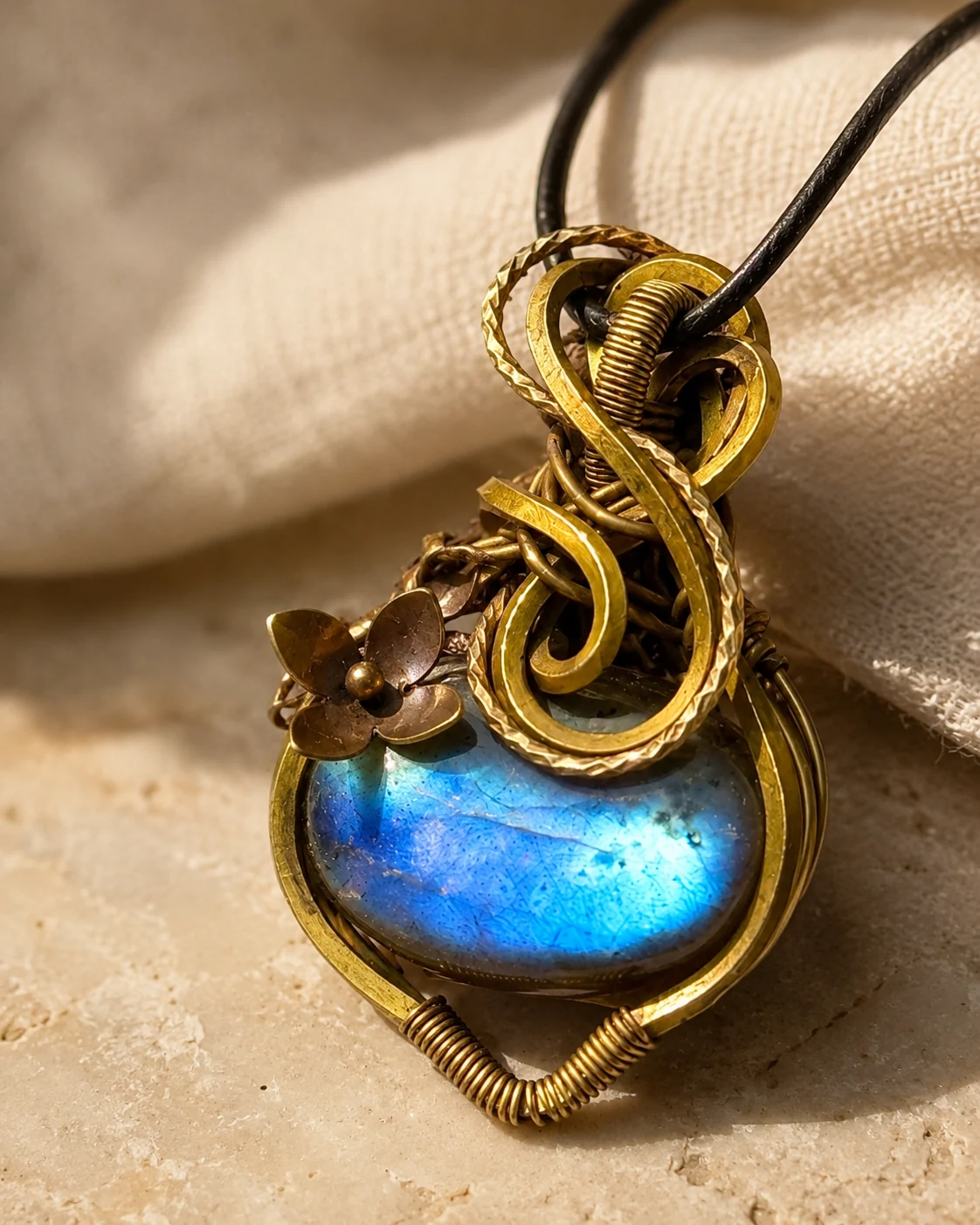
Labradorite is a feldspar, and its defining behaviour is optical rather than chemical. Light enters the stone, meets microscopic layers inside it, and comes back out as colour that appears to move as the stone moves. That effect is called labradorescence, or more simply, flash.
Almost everything that matters when choosing a piece follows from that one fact: the stone you buy is not the stone you saw in the listing photo. It is the stone under your kitchen light, at your desk, on a grey afternoon.
What flash actually is
Inside labradorite are stacked microscopic planes, slightly misaligned with each other. Light passing through and reflecting off them interferes with itself, cancelling some wavelengths and reinforcing others. The result is a narrow band of colour that only appears within a limited viewing angle.
That is why labradorite can look flat grey from one direction and electric blue from another. It is also why a photograph is a poor judge: the photographer chose the angle where the flash was strongest.
The colours you will actually see
Blue is the most common and the most recognisable. Other colours exist and are rarer:
| Flash colour | How common | What it reads as |
|---|---|---|
| Blue | Most common | Cool and graphic; works with silver and denim |
| Green | Common | Softer, more organic; pairs well with warm skin tones |
| Gold | Less common | Warm and unusual; tends to look expensive |
| Purple / violet | Uncommon | Deep and slightly mysterious; rare in large clean areas |
| Multi-colour | Rare | Two or more colours across one stone; the most sought after |
A well-cut labradorite usually shows a single colour across its face. A stone showing several colours at once can be spectacular, or it can be visually busy. Neither is objectively better — but be suspicious of listings that promise a specific colour without showing the stone at several angles.
Body colour matters more than most buyers think
Body colour is the base tone of the stone itself, before any flash. Labradorite ranges from near-transparent grey through to dark charcoal.
- Lighter bodies — allow more light through, so the flash can appear brighter — but they also show inclusions and grey more openly.
- Darker bodies — give flash an intense, jewelled quality against a black backdrop, at the cost of looking dull when the flash is out of view.
- Mid-grey bodies — are the most forgiving and the most common choice for everyday pieces.
The practical rule: a darker body with strong flash is the safer buy, because the contrast makes the flash read clearly even in poor light. A very pale stone with weak flash is the one that disappoints most often.
Cut and setting change everything
The same rough stone behaves very differently depending on how it is cut and how it sits in metal.
Cabochons
Smooth domed cuts, the traditional choice. They present the largest possible surface for the flash and take a quiet, sculptural look in a bezel setting. This is what most labradorite pendants use.
Faceted stones
Faceting adds sparkle but can break up the flash into disconnected fragments. Well-faceted labradorite can be striking; poorly faceted labradorite usually ends up looking muddled.
Freeform and carved
Cut to follow the stone rather than a template. These hold the largest areas of uninterrupted flash, which is why many one-off pieces are freeform. Our Flow-Wrapped Labradorite Pendant is cut this way.
Setting
An open-backed setting lets light pass through the stone and generally brightens the flash. A closed back gives a heavier silhouette but can dull the effect. If you are buying for the flash, ask about the back.
What is acceptable — and what is not
Labradorite is a 6–6.5 on the Mohs scale. It is a real stone, not a soft decorative one, and it will show signs of its formation. Understand the difference between character and damage:
| Feature | Acceptable | Avoid |
|---|---|---|
| Inclusions | Fine internal lines that do not break the surface | Cracks that catch a fingernail |
| Flash coverage | Most of the face flashes at some angle | Flash confined to a thin sliver |
| Surface | A tiny natural pit or soft edge | Chips at the edge of the setting |
| Colour variation | Slight tonal shift across the face | Large dead grey zones |
How we choose stones
Every labradorite piece we make is a single stone, chosen individually rather than assigned from a grade bin. We look for flash that holds through a wide rotation, a body colour that supports it, and a cut that follows the stone instead of fighting it.
Because of that, exact colour cannot be promised in advance. What we can promise is that the stone will be selected for character, and that we will photograph it before setting it when the exact look matters to you.
No two pieces of labradorite are alike. That is not a limitation of the material — it is the reason to choose it.
Buying labradorite online without regret
- Ask for at least three photographs — flash visible, flash turned away, and the back of the setting.
- Ask whether the piece is one stone or several. Composite pieces hide weak stones.
- Prefer sellers who describe the stone's behaviour in words, not just superlatives.
- If the exact stone matters, ask for a photograph of your stone before it is set.
That last point is the one that prevents most disappointment. A good studio will do it without being asked twice.