
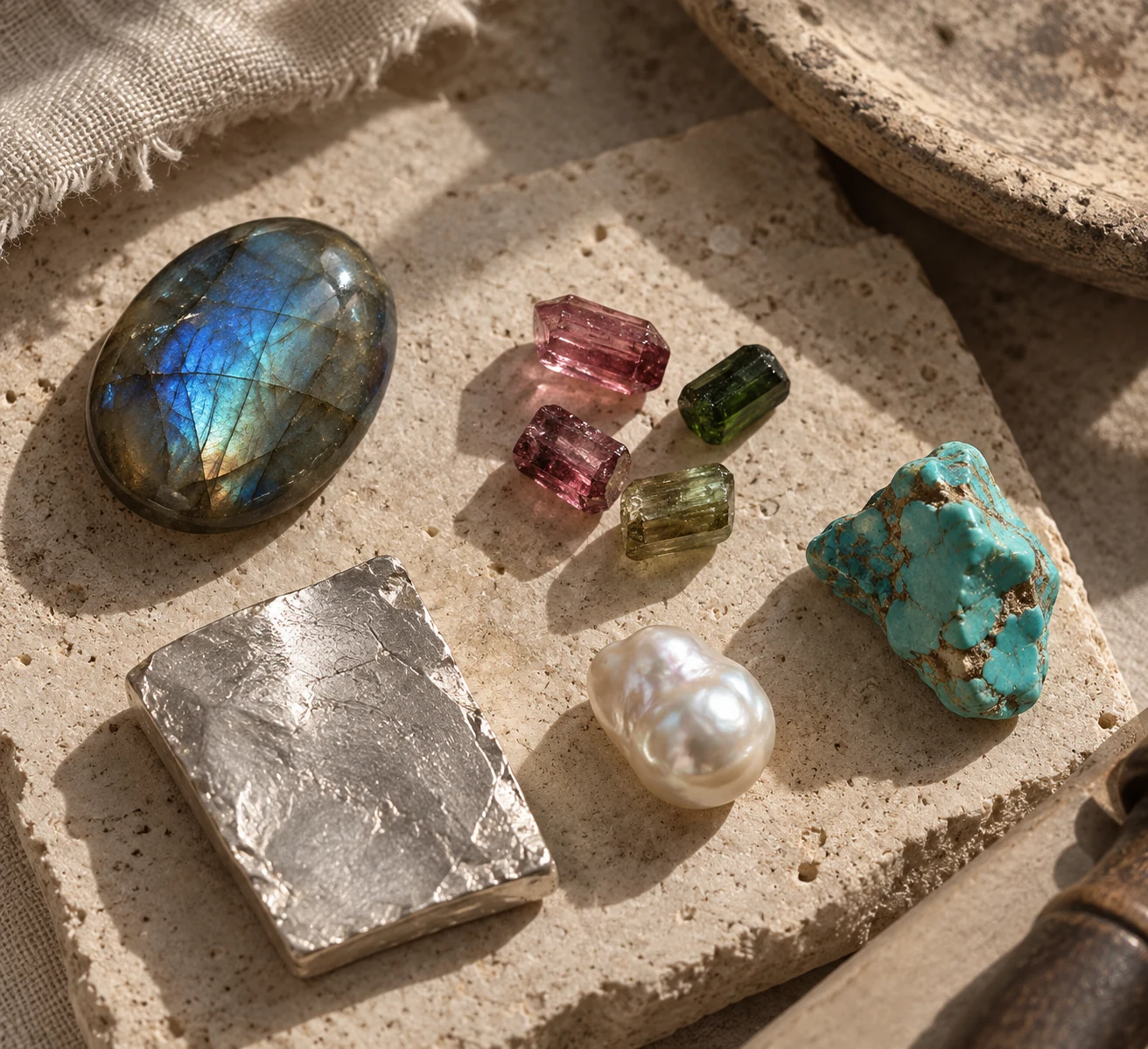
Natural stones are not fragile in the way people assume, but they are specific. Each mineral has its own hardness, its own chemistry and its own reaction to water, heat and household products. Treating them all the same is how pieces get ruined.
The four habits below prevent the overwhelming majority of damage. Everything after that is detail.
The four habits that matter most
- Last on, first off. Put jewelry on after perfume, lotion and hairspray have dried. Take it off before washing up, showering or cleaning. This single habit prevents most surface damage.
- Store separately, not in a pile. Stones scratch each other. A soft pouch per piece, or a lined box with dividers, is enough.
- Keep it dry by default. Not because water is dangerous to most stones, but because it carries soap, chlorine and salts into settings and drill holes where they dry and leave residue.
- Clean gently and rarely. A soft dry cloth after wearing does more good than any deep clean. Aggressive cleaning causes more harm than skipping it.
What each material actually tolerates
| Material | Hardness | Water | Ultrasonic | Chemicals | Notes |
|---|---|---|---|---|---|
| Labradorite | 6–6.5 | Brief, fine | No | Avoid | Surface dulls from oils; a soft cloth restores it |
| Tourmaline | 7–7.5 | Fine | Rarely | Avoid | Hard and stable, but heat-sensitive in some colours |
| Turquoise | 5–6 | No | Never | Never | Porous and often treated; absorbs oils and darkens |
| Lapis lazuli | 5–6 | No | Never | Never | Contains pyrite; sensitive to acids and heat |
| Pearl | 2.5–4.5 | No | Never | Never | Softest of all; damaged by perfume and dry air |
| Moonstone | 6–6.5 | Brief, fine | No | Avoid | Cleaves along internal planes; avoid impacts |
| Amethyst / quartz | 7 | Fine | Yes | Avoid | One of the most tolerant stones |
How to clean, by material type
Hard stones (7 and above): tourmaline, quartz, amethyst
These tolerate warm water and a drop of mild soap. Use a soft brush, rinse, and dry with a lint-free cloth. Do not soak for long periods even so — the goal is to clean the stone, not the setting.
Mid-range stones (6–6.5): labradorite, moonstone
Wipe with a slightly damp, soft cloth, then dry immediately. Do not soak and do not brush. For labradorite that has gone dull, a gentle polish with a soft dry cloth usually brings the flash back — the stone itself has not changed, only its surface.
Porous and soft stones (below 6): turquoise, lapis, pearl
Dry cleaning only. A soft dry cloth after each wear. Never water, never soap, never ultrasonic. Pearls should be wiped with a soft cloth before being put away, and stored away from dry heat — which is what cracks pearl nacre over years.
What to avoid entirely
- Ultrasonic cleaners — Safe for maybe a third of the stones we work with, and the failures are often invisible until a stone cracks weeks later.
- Silver dip on stones — The chemical is formulated for metal. It attacks porous stones, dissolves some treatments and dulls pearls permanently.
- Baking soda or toothpaste — Abrasive. It removes the polished surface layer from soft stones and leaves a permanently matte finish.
- Steam — Thermal shock cracks stones with internal inclusions. Tourmaline and quartz are the usual casualties.
- Chlorine and salt water — Both attack silver and degrade silk thread on pearls. Take jewelry off before swimming.
- Perfume, hairspray and sunscreen — The single most common cause of damage. Apply them first, wait for them to dry, then put jewelry on.
Storing natural stone jewelry
- Separate, always — One pouch per piece. Chains tangle and their links abrade softer stones.
- Dry, not humid — A bathroom is the worst room for jewelry. Humidity accelerates silver tarnish and residue build-up.
- Not airtight for pearls — Pearls need a little ambient moisture. Airtight storage over decades dries the nacre.
- Hang necklaces — Reduces flexing at the clasp, which is where chains fail.
If you want a piece to stay bright between wears, a tarnish-inhibiting strip in the box genuinely helps. See why sterling silver tarnishes for the chemistry behind it.
When to stop cleaning it yourself
Three situations call for professional attention rather than a cloth:
- A stone has become loose in its setting or wrap. Continuing to wear it risks losing the stone.
- A setting has caught on clothing and bent. Straightening it yourself usually causes the wire or prong to work-harden and crack.
- Heavy tarnish has built up in an intricate piece. Harsh chemical strips used at home damage stones; a jeweller can clean the metal while protecting them.
For most pieces, none of this is needed for years. Good habits at the start do far more than repairs at the end.
The short version
Wear jewelry last, take it off first, store pieces separately and keep them dry. Clean hard stones with water and soft stones with a dry cloth. Never put a natural stone in an ultrasonic cleaner or silver dip.
Do that, and a well-made piece will look the way it looked on the day it arrived for a very long time. Our care guide covers metals and shipping, and the labradorite guide covers what to expect from that stone specifically.