
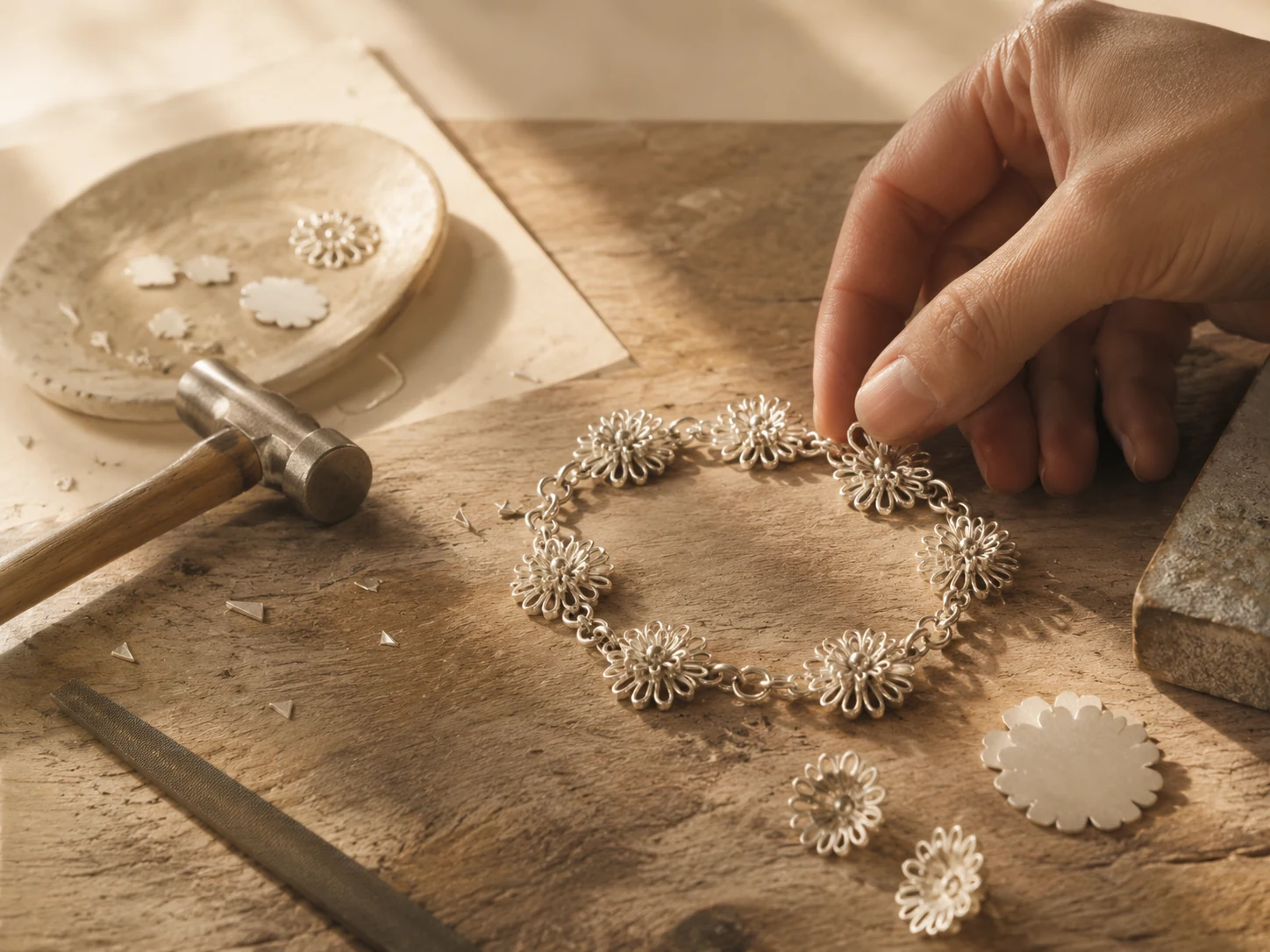
Wire-wrapped jewelry is made by forming metal wire around a stone to hold it, rather than cutting a seat into metal. There is no glue, no prong setting and — in good work — no solder. The stone is held entirely by the tension and geometry of the wire.
The technique is old. It predates modern setting by a very long way, precisely because it works: it needs no specialised tooling, and it can accommodate stone shapes that a conventional setting cannot.
How it is actually made
- Stone selection — The stone comes first. Its shape, thickness and any natural asymmetry determine what the wrap has to do.
- Wire preparation — Dead-soft or half-hard wire is selected by gauge. Too soft and the piece deforms; too hard and it work-hardens and cracks mid-wrap.
- Cage forming — The wire is brought around the stone in a sequence of passes. Each pass is tensioned against the previous one, which is what creates the grip.
- Securing — Ends are tucked and coiled rather than glued. A well-finished wrap has no sharp wire ends anywhere on the wear side.
- Finishing — The whole piece is polished, and optionally oxidised to darken the recesses and make the wire pattern read more clearly.
A good wrap holds the stone by geometry, not by force. Nothing is glued, and nothing is over-tightened.
Why it holds up better than it looks
People assume wire-wrapped pieces are fragile. Usually the opposite is true, for three reasons:
- The stone is supported all round — A prong setting touches the stone at four or six points. A wrap distributes pressure across the whole girdle, which is much kinder to a stone with internal inclusions.
- Tension is distributed — Multiple passes share the load. One wire loosening slightly does not release the stone.
- There is no solder joint to fail — Solder is where most jewelry breaks. A wrap with no solder has one less failure mode.
The real weakness is different: wire fatigue. Bending any metal back and forth enough times will break it. This matters for bracelets and rings far more than for pendants, which mostly hang rather than flex.
Five details that separate good work from rushed work
| Detail | Careful work | Signs of a rush job |
|---|---|---|
| Wire ends | Tucked, coiled and polished flush | Sharp ends, or ends hidden under the stone |
| Tension | Even all round; stone does not shift | Loose in places; stone rocks when pressed |
| Symmetry | Deliberate — either symmetrical or clearly asymmetric | Almost symmetrical, which reads as a mistake |
| Solder | None on a traditional wrap | Visible blobs from fixing a failed wrap |
| Finish | Polished into the recesses | Bright on top, dull and oxidised-looking underneath |
The tension test is the quickest one: press the stone gently with your thumb. It should not move relative to the wire. If it does, the wrap is not finished.
Why it suits natural stones so well
Conventional setting wants regular shapes. Natural stones are frequently irregular — a labradorite with an uneven edge, a tourmaline crystal that tapers, a piece of raw material that was never going to become a calibrated oval.
Wire wrapping takes the stone as it is. That is why so much labradorite work is wrapped rather than set: the most interesting stones are often the least regular. Our Labradorite Sword Pendant and Labradorite Teardrop Collar both use this approach.
What wire-wrapped jewelry is not
- It is not automatically “cheap” — Good wrapping is slow, skilled work. A complex wrap can take longer than setting the same stone conventionally.
- It is not inherently fragile — But fine-gauge wire on a ring worn daily will eventually fatigue. Choose weight appropriate to the wear.
- It is not a substitute for a bezel on a ring — For rings, a bezel is usually the more durable answer. Wrapping shines for pendants, earrings and statement bracelets.
Caring for a wire-wrapped piece
Less complicated than people expect. Keep it dry, avoid catching the wrap on knitwear, and store it flat rather than in a tangle with chains. Clean with a soft cloth and warm water; skip ultrasonic cleaners, which can work-hardened wire loose.
Occasional gentle reshaping of a slightly bent wire is normal and can be done with fingers. Do not use pliers — they leave marks and can over-bend. Full guidance is in our care guide.
Buying checklist
- Press the stone. It should not move.
- Run a fingertip around the back. You should feel no sharp wire ends.
- Check the tension is even, not tight in one area and loose in another.
- Ask what gauge wire was used, and whether it is sterling throughout.
- Ask whether the piece has any solder. On a traditional wrap, the answer should be no.