
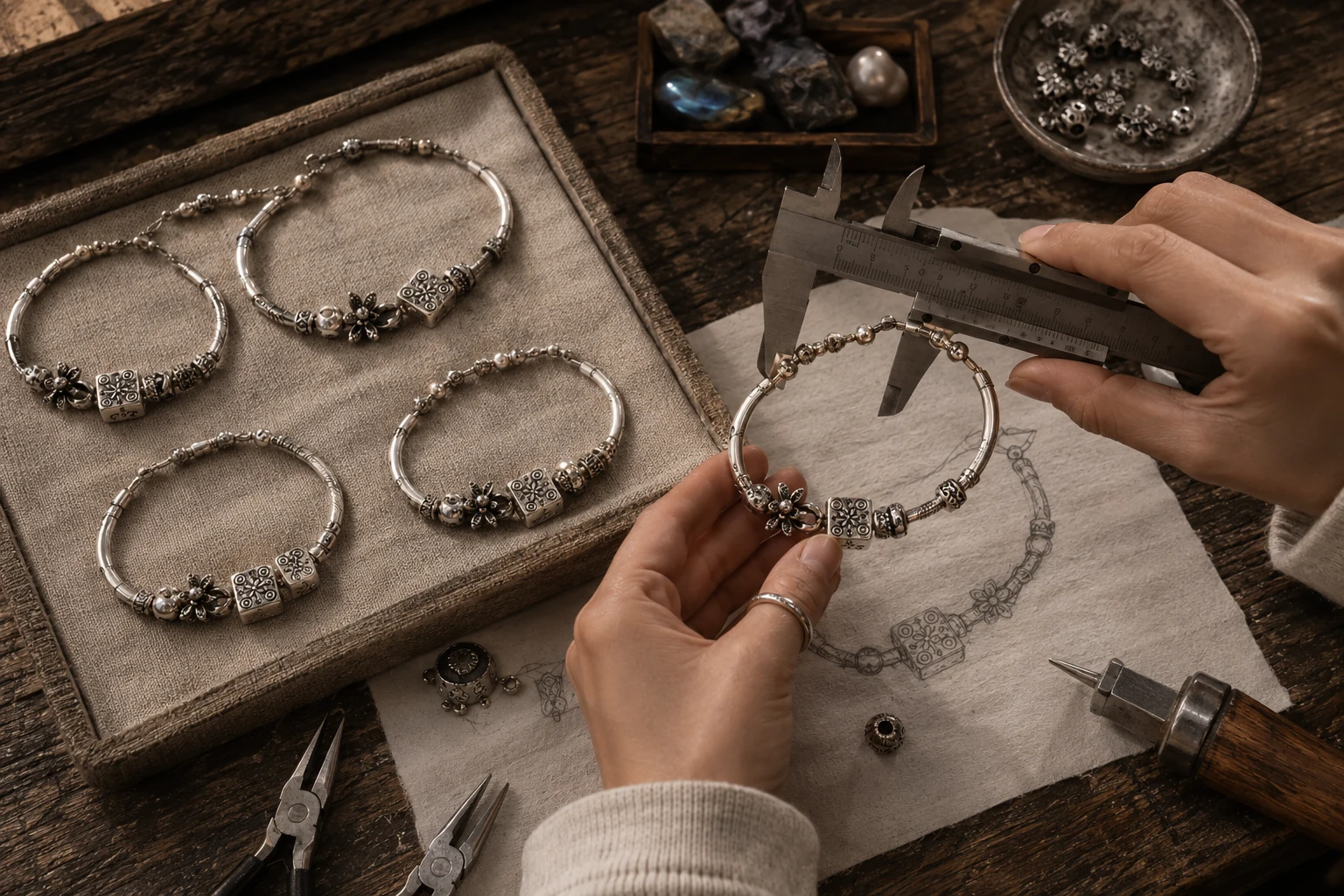
Turn over any silver piece and you will usually find small stamped characters. Most buyers cannot read them, and plenty of sellers cannot either. Here is what the marks actually mean.
The numbers
925, 925/1000, Ster, Sterling — the piece contains 92.5% silver. This is the international standard for sterling and the mark to look for.
999 / 9999 — 99.9% or 99.99% fineness. This is fine silver. It resists tarnish far better than sterling but is too soft for most jewelry, so it appears in bullion, coins, and some hollow or lightweight sterling construction where the silver is the visible surface.
800, 830, 835, 900 — European fineness standards, all lower than 925. Common in vintage continental pieces. They are real silver, just with more copper in the mix.
Coin or brand stamps — "935" or a sovereign mark sometimes indicates the piece was made from reclaimed coin or scrap. It is a hallmarking tradition rather than a quality signal.
The letters
A single letter — S, E, F, T and so on — is usually a maker's mark: the silversmith, workshop or manufacturer. Several grouped letters may form a maker's surname or a guild mark.
Some marks are obligation marks applied by an assay office. Others are purely decorative signatures added by the studio. There is no universal letter code, so a single stamp tells you very little on its own.
Regional systems at a glance
| Region | Typical marks | Note |
|---|---|---|
| UK | Anchor, lion passant, leopard's head, date letter | Full assay-office hallmarking with year and maker |
| Germany / Austria | Numerical fineness (800, 830, 900) | Fineness figures were legally required |
| US | STERLING, 925, S, STER | Sterling is a legal term; "silver" alone is not |
| Italy | 925 with a provincial abbreviation | Province letter is part of the standard mark |
| Japan | SEAL, S925, numbers | Precious metal law requires specific seal shapes |
What a hallmark does not tell you
- Nothing about workmanship. The stamp is about metal, not about the making.
- Nothing about condition. A heavily worn piece keeps its mark.
- Nothing about plating. A plated piece may carry a sterling-looking stamp from a component maker. Check the findings, not only the body.
TRIJORA stamps sterling silver throughout — body, clasps and chain — so a piece is consistent from end to end.
Frequently asked
Where are silver hallmarks usually found?
Inside a ring band, on the inside of a bracelet clasp, on the back of a pendant, or on a small tag attached near the clasp. On a chain, look at the clasp or the end links.
Does 9999 mean it is pure silver?
It usually indicates 99.99% fineness, which is standard for bullion and for sterling silver used in some Asian markets. It describes purity only — it says nothing about workmanship or whether the piece is well made.
Is a stamped piece automatically valuable?
No. A hallmark is a claim about metal content, not about design quality or price. Plenty of well-hallmarked pieces are poorly made, and some unmarked handmade pieces are excellent.
What does a letter stamp mean?
A single letter such as S, E or F usually denotes the silversmith or manufacturer. Some makers use it as a signature. It identifies who made the piece, not what it is made of.