
A custom order going wrong is rarely a story about craftsmanship. It is usually a story about two people who each believed they had understood the same sentence.
The fix is unglamorous: put the right information in the first message. It takes ten minutes and it removes most of the ways a commission can disappoint.
The five things to send
- What it is — Necklace, ring, bracelet, earrings, brooch, or something else entirely. Obvious to you, not always obvious from a photograph.
- A reference — A photograph, a screenshot or a link. Even an imperfect one. Like this, but shorter and with a different stone is a complete brief.
- Material preference — Silver, a specific stone, a colour you are trying to match, or no preference — advise me. All three are useful answers.
- Your measurement, or that you do not have one — A wrist, a finger, a neck length. If you do not know, say so and ask. Guessing is the single most common cause of a remake.
- When you need it, and your budget if you have one — The date shapes what is possible. A budget range, even a rough one, shapes which stone and which level of detail make sense — and it is a more useful conversation than a number arrived at after the fact.
What a good reference image contains
Not all references are equally useful. The ones that shorten a quote the most share a few properties:
- It shows proportion — A piece photographed on a hand, a wrist or a neck conveys scale in a way a flat-lay never does.
- A full view rather than a detail crop — A close-up of a clasp is useful, but it is not the brief. Send the whole piece first.
- Two or three views if the shape is unusual — Front and side. This is where what it looks like from the back stops being an open question.
- An honest statement of what you like about it — I like the shape, not the finish is information. Without it, a studio may reproduce the wrong quality.
The four gaps that cause most problems
| The gap | What happens | How to close it |
|---|---|---|
| No measurement, no guess stated | The piece is made to a default size and may not fit | Say you do not know and ask to be walked through it |
| The reference is in your head only | The maker interprets, and interprets differently | Send any image that is close, and say what is wrong with it |
| Budget never mentioned | The quote comes back for a different material than you had in mind | Give a range; it selects the material, not just the price |
| Date not stated | The making window is quoted from today, and it is too late | Say the date in the first message |
Words worth knowing
You do not need much vocabulary to commission a piece, but a handful of terms remove a lot of back-and-forth:
- Cabochon — A smooth, rounded stone with no facets. Common in labradorite and turquoise work.
- Bezel setting — A ring of metal holding the stone around its edge. Protects the stone; suits irregular shapes.
- Prong setting — Thin metal claws holding the stone. Shows more of the stone; exposes its edges.
- Baroque pearl — An irregular, non-spherical pearl. Valued precisely for the variation that a round pearl does not have.
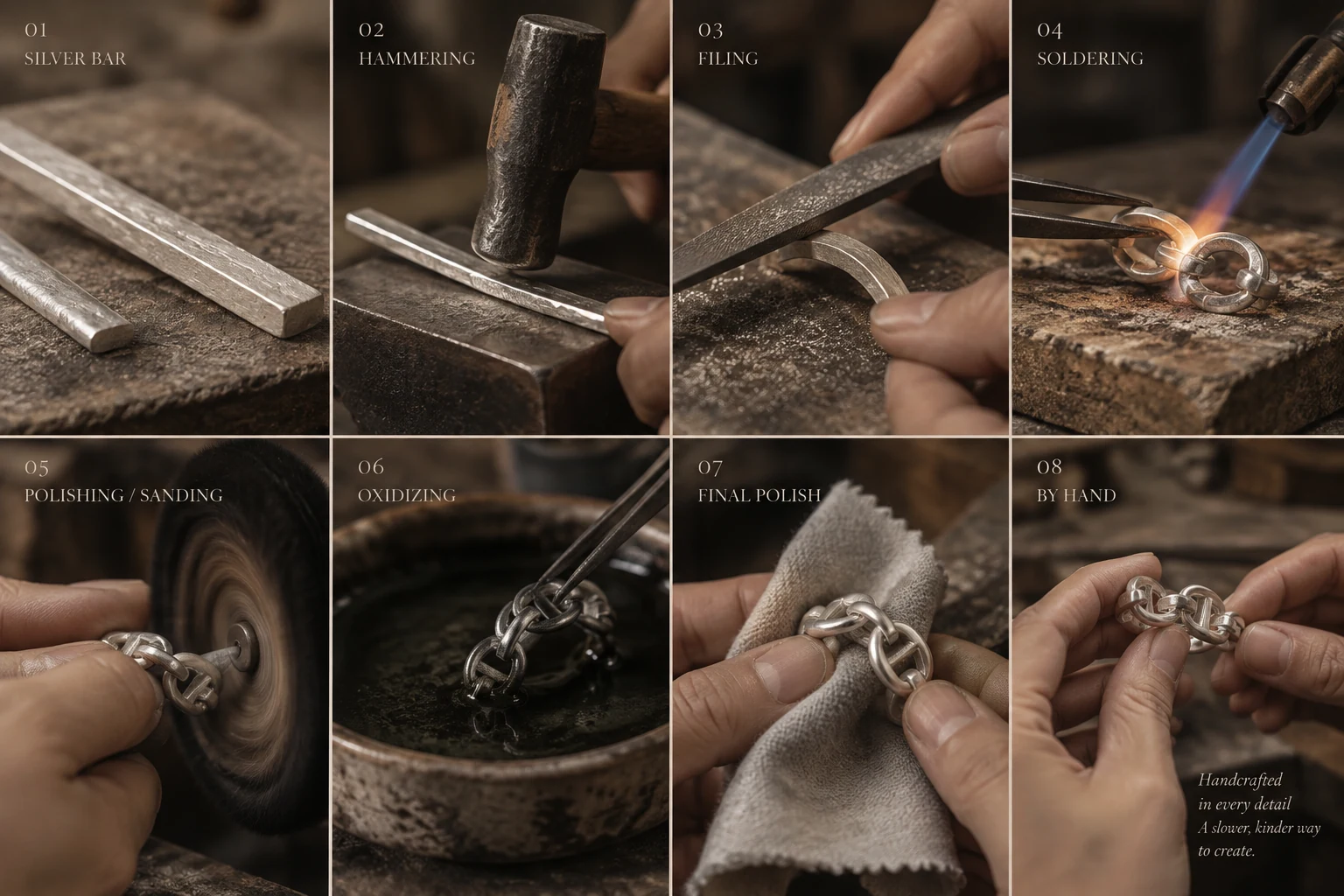
- Patina / oxidation — Deliberately darkened silver in the recesses to bring out texture. Often mistaken for tarnish.
- Wire wrapping — Forming a piece from wire rather than casting or sheet metal. Gives a particular handmade character.
What should happen after you send it
A brief that lands well should get you three things back, and none of them should be a surprise later: confirmation that the piece is feasible, an indication of any part that is not, and a written quote before anything starts.
If a detail is impossible — a stone in a size that does not exist, a deadline that cannot be met, a shape that will not hold — you want to hear it at that point rather than at the end. A studio that says no early is doing you a favour.
After that, the useful discipline is on your side: once the design and materials are confirmed, leave them alone. Changes after that point are the main reason custom orders run long and run over.