
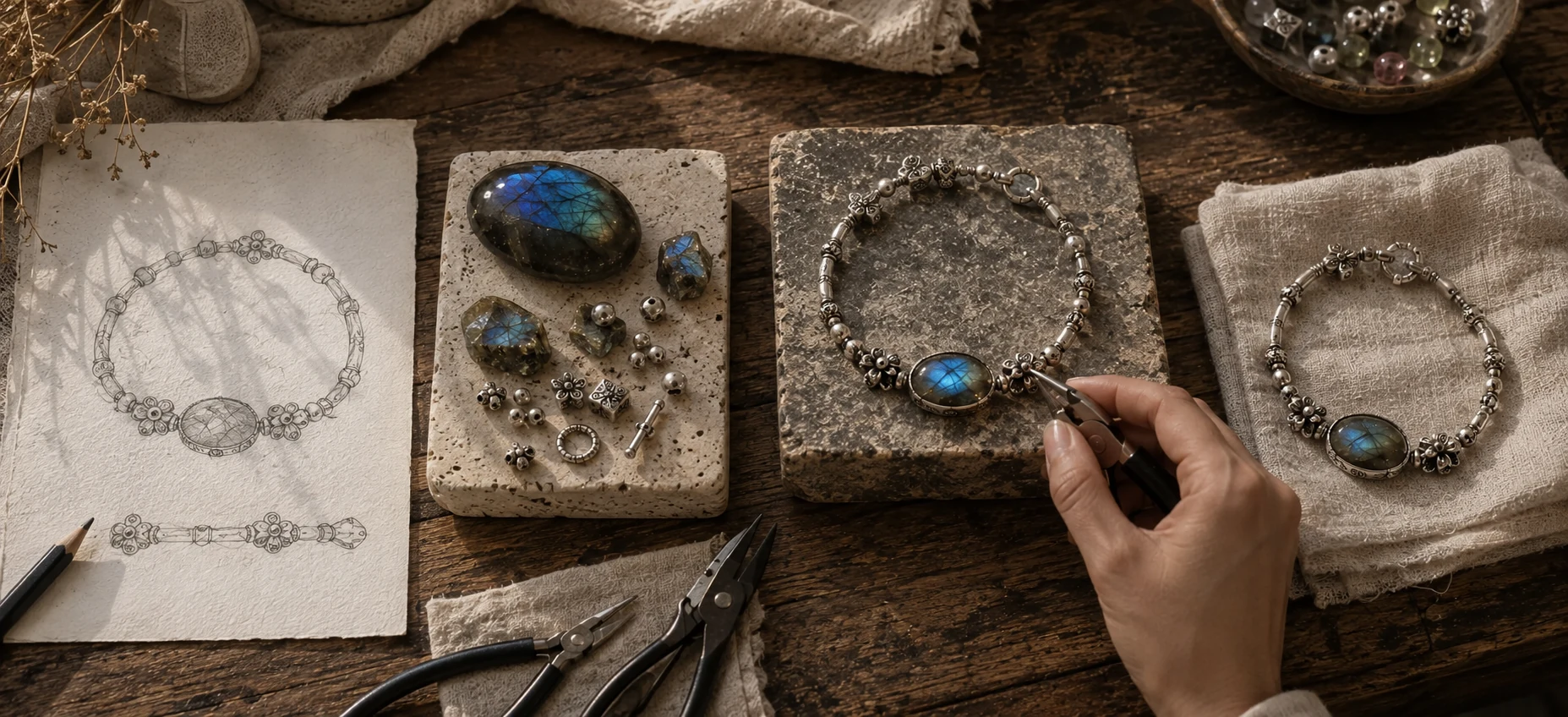
If you run a shop, a label or a studio of your own, at some point you face a fork: keep buying finished stock at wholesale prices and accept someone else's design decisions, or commission production and take control of the product.
The second option has a reputation for being inaccessible — months of negotiation, large minimum orders, tooling costs. That is true of industrial manufacture. Small-batch studio production is a different thing entirely.
What “small batch” actually means
There is no universal definition, but in practice:
| Run size | What it usually means | Typical approach |
|---|---|---|
| 1–5 | Bespoke or sample | Full hand-making; setup cost dominates |
| 10–50 | Core small-batch range | Hand production with jigs for repeatability |
| 50–200 | Small commercial run | Cast components plus hand finishing |
| 200+ | Factory territory | Moulds, tooling, contract manufacture |
For most independent brands, the useful range is 10 to 100 units. Below ten, per-unit cost is painful. Above a few hundred, you are better served by a factory — and we will say so.
Why unit cost falls so sharply
This is the part that surprises first-time buyers. Producing 30 bracelets does not cost 30 times one bracelet. It costs far less per piece.
The reason is that a large share of a first piece is thinking and setup, not material:
- Design development and confirmation — Paid once.
- Making of jigs, templates or reusable forms — Paid once.
- Stone selection and matching across the run — Partially shared.
- Learning the piece — the first few are always slower — Paid once.
Material and hand time scale with quantity. Setup does not. That is the whole mechanism.
What to settle before the first run
- Exact specification. Measurements, metal, stone, finish, clasp. Everything the maker needs to reproduce the piece without asking.
- Stones: matched or varied? Decide whether the run should look uniform or deliberately individual. This affects sourcing time and price substantially.
- Tolerance for variation. Hand-finished runs are not pixel-identical. If your market expects uniformity, say so early.
- Packaging. Whether pieces arrive individually boxed, or loose for you to pack.
- Delivery schedule. Whether you need everything at once or in tranches.
The points where runs go wrong
- Specification drift — Small changes mid-run break consistency. The pieces made before the change do not match the ones after.
- Unclear stone expectations — Natural stones vary. If specifications say “blue labradorite” without a tolerance, someone will be disappointed.
- Skipping the sample — A single approved sample prevents almost every dispute. Take the time.
- Underestimating finishing — The last 10% of a piece — final polish, setting check — is where the quality lives. Cutting it to save time is the most expensive shortcut available.
- Assuming “handmade” means “identical” — It does not. Handmade means made by hand, and hand work has a range.
What a studio is good at — and not good at
Being clear about this saves months.
| Studio production | Factory production | |
|---|---|---|
| Setup cost | Low — often no tooling | High — moulds and dies |
| Cost at 20 units | Reasonable | Usually uneconomic |
| Cost at 5,000 units | Uncompetitive | Very low |
| Design changes | Feasible mid-project | Expensive after tooling |
| Consistency | Close, but hand work varies | Highly uniform |
| Character | Visible hand marks, individual stones | Uniform, machine-finished |
A studio is the right choice when the product is design-led, the quantity is modest, and the variation is part of the value. It is the wrong choice when you need thousands of identical units cheaply.
What to send
- Photographs of the design, or the actual sample if you have one.
- Quantities, and your target unit price.
- Deadline, and whether it is fixed.
- Market context — where the pieces will be sold, and at what retail price. This is not nosiness; it tells us where to spend on materials and where not to.
- Whether you need one run or an ongoing supply.
Send those five things and the first reply will contain a real number rather than a list of questions. Our custom and small-batch page covers the current options and lead times.