
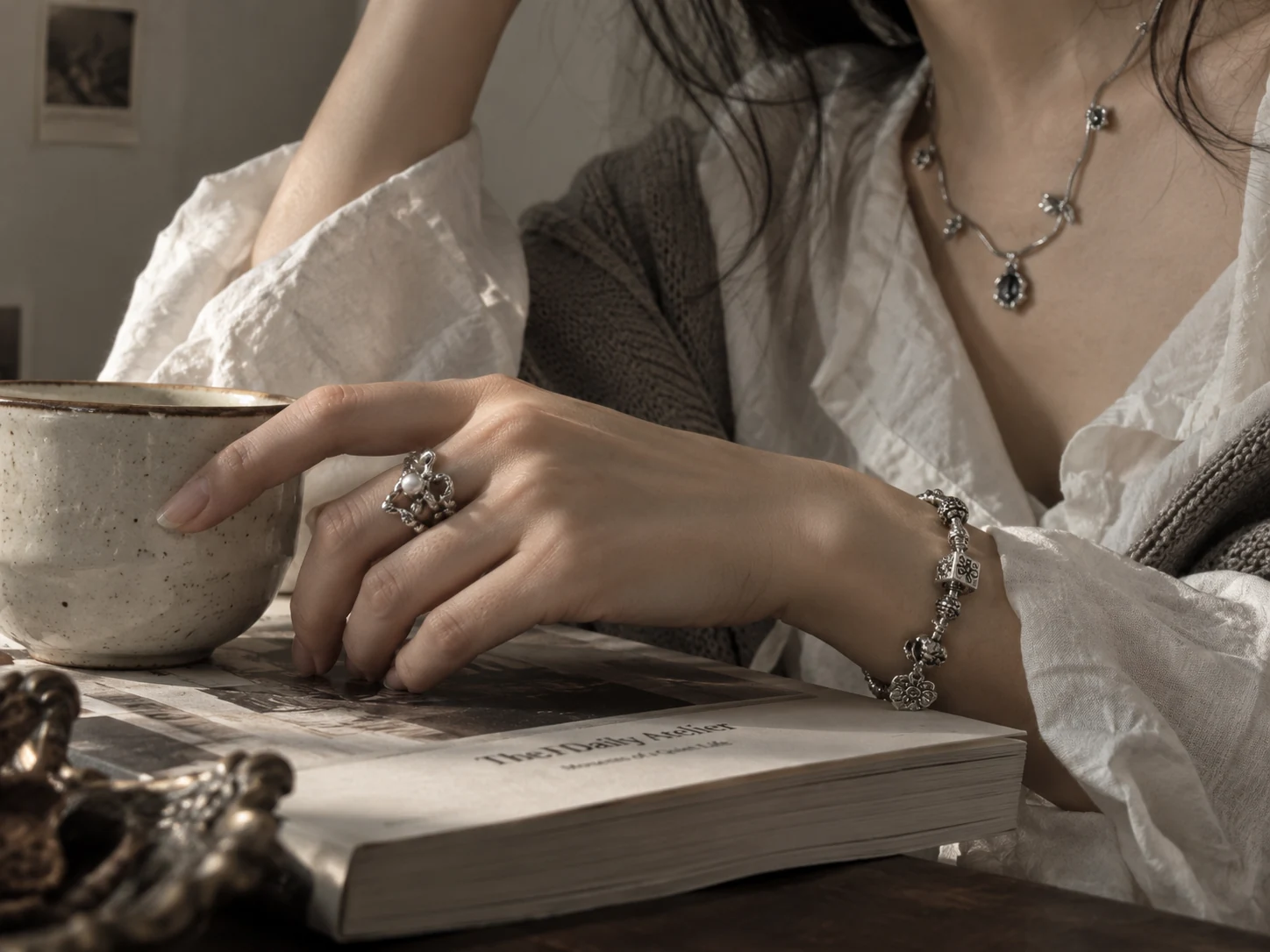
Jewelry is a difficult gift because it is personal in a way most objects are not. It sits against skin, it gets noticed, and it has to match a wardrobe and a way of moving. A piece that is slightly wrong does not get worn — it gets stored.
The good news is that the things that go wrong are predictable, and almost all of them can be checked in advance.
Start with what they already wear
Before thinking about what to buy, look at what is already in rotation. This is the highest-value five minutes in the whole process.
- Which pieces do they wear daily? That is the silhouette to match. Most people have a default — a thin chain, a single ring, small studs — and a gift that fits that default gets worn.
- Which pieces sit unworn? The opposite answer, and just as useful. If a bold statement necklace has never been on, that is not the direction.
- What metals appear? Silver, gold, mixed. Most people are consistent. Silver-toned jewelry given to someone who only wears warm gold tends to go unworn, regardless of how good it is.
- What scale? Delicate or substantial. This matters more than the design itself.
The three things that go wrong
| Failure | What it looks like | How to prevent it |
|---|---|---|
| Wrong size | Bracelet too tight, ring unwearable, chain sits wrong | Measure unobtrusively, or choose a style that is forgiving |
| Wrong scale | The piece is visually timid, or overwhelming | Match what they already wear |
| Wrong material | Plated metal that discolours, or a stone that cannot be worn daily | Prefer sterling silver and stones rated 6+ on Mohs for daily pieces |
Of the three, size is the most damaging and the most avoidable. A bracelet that does not fit is not a slightly imperfect gift — it is a non-gift.
Getting the size without spoiling the surprise
You do not need to ask. Several approaches work:
- Borrow a piece. Take a bracelet or ring they already wear and note its internal diameter (rings) or total length (bracelets). Measure it quietly and put it back.
- Choose a forgiving style. Pendants, earrings and adjustable chains avoid sizing almost entirely. For a first gifted piece, this is the safest category.
- Ask a sibling, partner or flatmate. Wrist and ring sizes are usually known by someone close.
- Buy a piece designed to be adjusted. An open cuff or an extender chain absorbs a size or two either way.
If you can only manage one thing, choose a category with no size risk. A pendant is worn by nearly everyone and fits by definition. See the silver collection for what that looks like in practice.
Natural stones: beautiful, and slightly unpredictable
A stone makes a piece feel considered. It also introduces variation, and a gift recipient who was expecting an exact colour may be surprised.
- Labradorite flashes differently at every angle — a genuinely showy gift for someone who likes unusual things.
- Pearls read as classic and are very hard to get wrong, provided they are cared for properly.
- Turquoise and lapis are striking but porous. A daily-wear bracelet in turquoise will absorb oils and change over time.
- Quartz and tourmaline are the most robust choices for something worn constantly.
For anyone who wears the same piece every day, prioritise durability. There is more on this in choosing labradorite and in our materials notes.
Should you personalise it?
Engraving, a birthstone, a custom size or a shape with personal meaning all raise the sentimental value of a piece — and the risk, since personalisation is generally non-returnable.
Two rules keep it safe:
- Personalise the object, not the taste. A custom size, or a stone in a colour they already wear, is low risk. An initialled design in a style they have never worn is high risk.
- Confirm the detail in writing before production. Names and dates are easy to mistype and impossible to undo.
Custom work also takes longer. A bespoke piece typically takes up to 30 days to make, plus shipping — worth factoring in if the date is fixed. Our custom page sets out the timeline.
A quick decision path
- Do you know their size? If no, choose a pendant, earrings or an adjustable style.
- Do they wear silver or warm metals? Match what is already in rotation.
- Delicate or substantial? Match the scale of their daily pieces.
- Daily wear or occasional? Daily means hard stone and a secure setting.
- Is there a date? If yes, check the making time before committing to a custom piece.
The best gifted jewelry is not the most impressive piece. It is the one that gets worn on an ordinary Tuesday.