
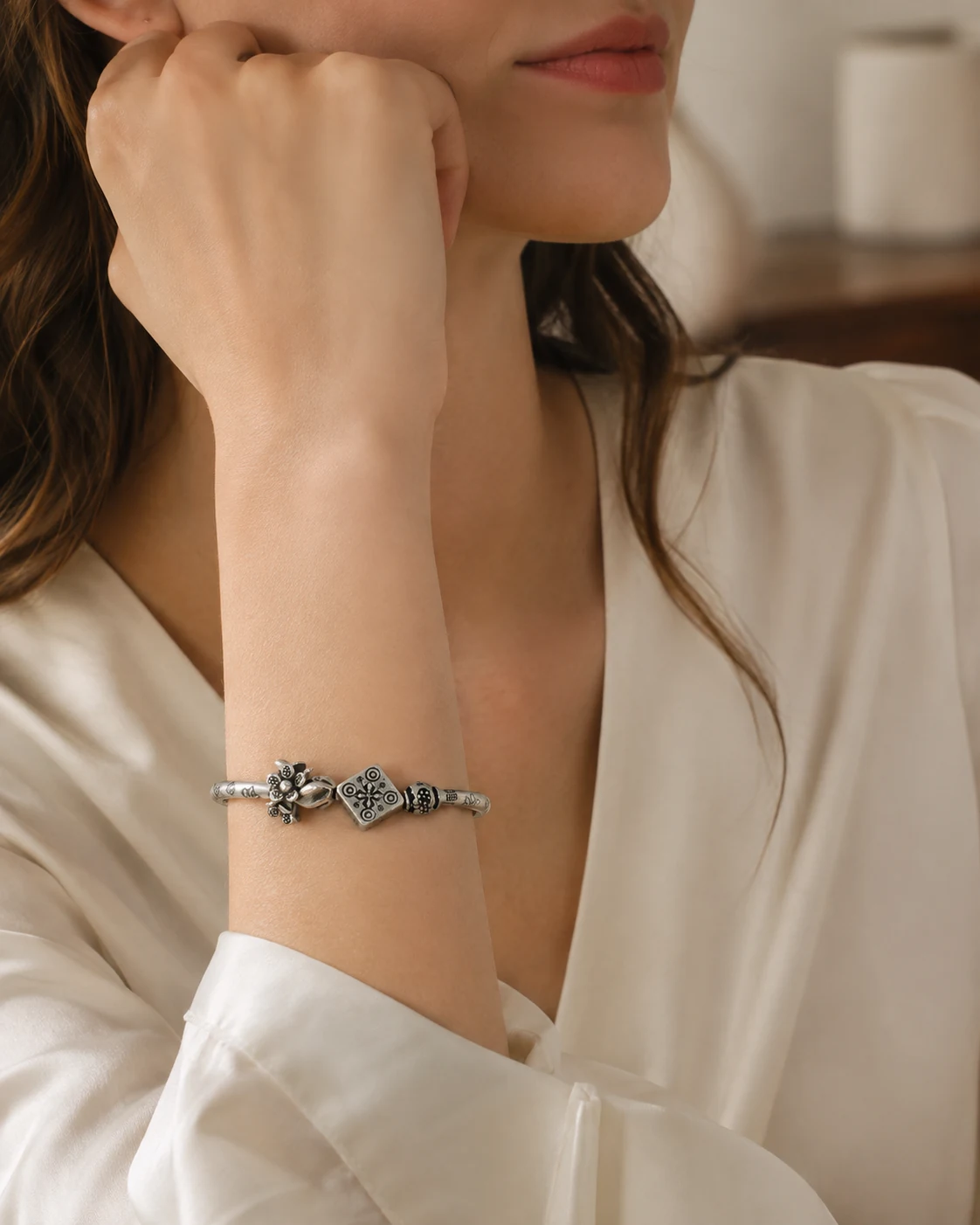
Wrist measurement is the single most common reason a bracelet gets returned or goes unworn. It is also the easiest thing to get right, if you measure the way a maker actually needs.
There are two numbers involved, and people confuse them constantly: your wrist circumference and the finished bracelet length. They are not the same, and the second one depends on the style of the bracelet.
Measure your wrist: two methods
Method 1 — tape measure
- Wrap a flexible tape measure around your wrist, just below the wrist bone.
- Keep it snug but not tight. You should be able to slide a fingertip underneath.
- Note the measurement in centimetres, to the nearest half centimetre.
- Measure twice. The first attempt is usually a little loose.
Method 2 — string and ruler
If you do not have a tape measure, wrap a strip of paper or a piece of string around your wrist, mark where it overlaps, then lay it flat against a ruler. It is just as accurate.
How much to add for the finished length
A bracelet needs to be longer than your wrist, or it will not fasten comfortably and will press on the wrist bone. How much longer depends on the design.
| Bracelet style | Add to wrist | Why |
|---|---|---|
| Fine chain with small clasp | +1.0 to 1.5 cm | Needs a little slack to hang and not dig in |
| Beaded / strung bracelet | +1.0 to 2.0 cm | Cord does not flex the way a chain does |
| Cuff or bangle (open at the back) | Width of the opening accounts for it | Measured by the gap, not the length |
| Wide band or solid cuff | +0.5 cm only | Sits high on the wrist, so it can be closer |
| Charm or heavy-link bracelet | +1.5 to 2.5 cm | Weight needs room to move without pulling |
If you are between sizes, go up. A bracelet can usually be worn slightly loose; one that is too tight is unwearable.
The fit test before you order
Rather than guessing, do this: cut a strip of paper to the finished length you are considering, wrap it around your wrist, and check three things.
- It should fasten without the ends having to be forced together.
- You should be able to slide one finger between the strip and your wrist, but not two.
- When you let your arm hang, the strip should sit about 1 cm below the wrist bone, not on top of it.
That is the fit most people end up happiest with.
Why handmade changes the calculation
Mass-produced bracelets come in fixed lengths — 16, 18 and 20 cm and so on. If none of those fits, you are out of luck. The industry quietly assumes an average wrist that does not exist.
A handmade bracelet is made to your measurement. That is the entire point. But it also means we can only work from the number you give us, so accuracy matters more, not less.
Two practical consequences:
- Give the measurement in centimetres, not as “small, medium, large” — Sizes are not standardised between brands. A number is unambiguous.
- Tell us the fit you want in words too — Snug against the wrist, or loose and hanging? That single sentence prevents most sizing problems. Our custom enquiry page takes both.
Measurements for necklaces and rings
The same principle applies, with different landmarks.
| Piece | How to measure | Add |
|---|---|---|
| Necklace | Circumference of your neck, plus your preferred drop | Depends on where the piece should sit |
| Ring | Internal diameter of a ring that already fits, in mm | Nothing — send the diameter, not the circumference |
| Earring drop | From the piercing to where you want the piece to end | Nothing |
For rings, use internal diameter in millimetres. Ring sizing sticks vary between countries and a 0.3 mm error is a full size. A diameter measurement is far more reliable than a letter or a number.
Five mistakes to avoid
- Measuring over a sleeve or a watch. Measure bare skin.
- Measuring in the morning, when wrists are slightly swollen. Measure in the afternoon.
- Measuring in cold weather. Wrists are measurably smaller when cold.
- Using a stiff ruler against the wrist. It will not follow the curve, so it reads short.
- Sending a bracelet length instead of a wrist circumference, without saying which it is.
Any of these can put the result out by enough to matter. None of them take more than a few seconds to avoid.