
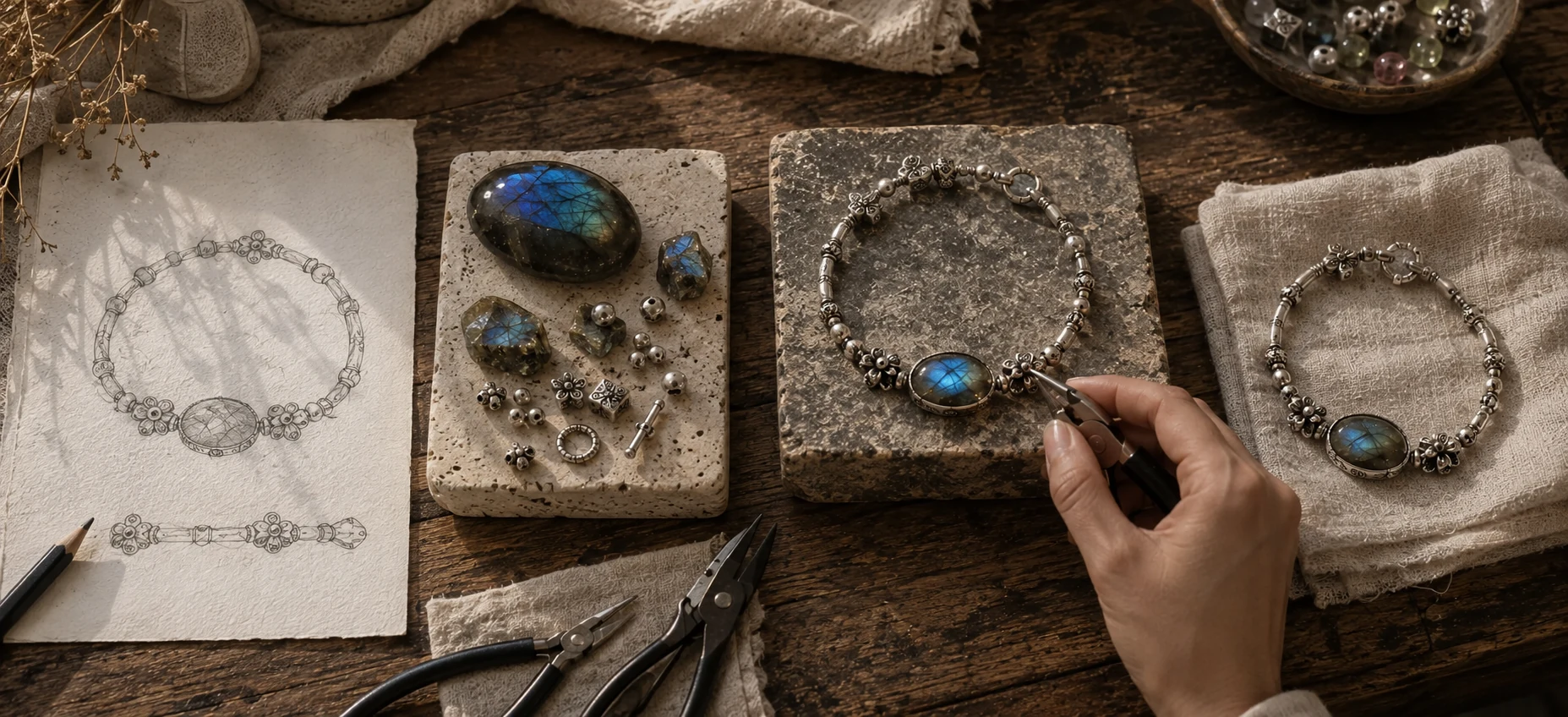
Custom silver jewelry manufacturing is less mysterious than it sounds — but it is also less instant than most people hope. Whether you are commissioning a single ring or ordering two hundred bracelets for a shop, the same six stages apply. Understanding them is the difference between a smooth project and three months of revisions.
TRIJORA produces both one-off bespoke pieces and small-batch runs, mostly in sterling silver with natural stones. This is the process we actually use, written out in full.
Why commission instead of buying off the shelf
Off-the-shelf jewelry is designed for the average wearer. That is efficient, and it is also why so much of it fits badly, reads generically, or uses a stone that was chosen for price rather than character.
Custom work solves a specific problem: you have a measurement, a material, a reference or an idea that stock designs do not cover. In practice, custom enquiries usually fall into one of four buckets:
- Sizing that standard pieces cannot meet — wrist and neck measurements outside the usual range, or an exact length that has to sit on a particular point.
- A material you already care about — a specific stone, a family stone, a colour you have been looking for. See our notes on natural materials for what is realistic.
- A piece that has to match something — a wedding set, an existing chain, a collection with a fixed visual language.
- A run for a brand or shop — the same design produced repeatedly, at a consistent standard, without the tooling cost of full industrial manufacture.
What can actually be customised
Almost everything, with two honest exceptions: physics and budget. This is the list we work from.
| Element | What is realistic | What is not |
|---|---|---|
| Metal | Sterling silver (925), fine silver, gold plating over silver | Solid gold without a significant price jump |
| Stone | Labradorite, tourmaline, turquoise, lapis, pearl, moonstone, quartz | Stones we cannot source at a verifiable quality |
| Size | Any wrist, neck, finger or ear measurement | Dimensions below structural limits of the metal |
| Form | Shape, proportion, texture, finish, clasp, chain style | Invisible mechanisms and micro-engineering |
| Finish | Polished, brushed, hammered, oxidised, matte | A finish that contradicts the form |
If you are unsure whether something is possible, ask. A short description and a reference image is usually enough to get a straight yes, no, or a cheaper alternative.
The six stages of a custom order
- Brief — You describe the piece — measurements, material, references, timing, quantity. Photos of something you like, and something you dislike, are worth more than a page of text.
- Feasibility and quote — We confirm what can be made, flag anything that will not work, and send a price with a making time. Standard making time on a bespoke silver piece is up to 30 days; a rush slot of about 10 days is sometimes available.
- Design confirmation — You receive a drawing or a first material selection. This is the cheapest moment to change your mind — before any metal is cut.
- Production — The piece is measured, shaped, soldered, set, filed and finished by hand. Natural stones are selected at this stage, which is why exact colour cannot always be promised in advance.
- Quality check — Dimensions are measured against the brief, the setting is tested, the finish is inspected under daylight and under a lamp.
- Delivery — Packed and shipped. Shipping time is additional to making time, and depends on destination and customs.
The cheapest place to change your mind is before the metal is cut. After that, every revision costs material and time.
What actually drives the price
Custom jewelry pricing is not arbitrary, but it is not linear either. Four things move the number most:
- Weight of metal — Silver is the baseline cost. A heavier piece is simply more expensive before anyone touches it.
- The stone — A well-chosen labradorite with strong flash can cost several times an ordinary one. This is usually the single largest variable.
- Hand time — Wire-wrapped and sculptural work cannot be machine-finished. Time is the second-largest line item.
- Quantity — Per-unit cost falls sharply with quantity because design and setup are paid once, not per piece.
Minimum quantities and small batches
There is no minimum for a single bespoke piece. For batch production, the practical floor is usually around ten units — below that, the setup cost dominates and you are effectively paying bespoke prices repeatedly.
Above roughly fifty units, we look at whether a different production route makes sense. Being honest about that early saves everyone money. Our custom and small-batch page sets out the current options.
What to send in your first message
A good brief is short and specific. Send these five things and the first reply will be useful rather than a list of questions:
- The type of piece — bracelet, necklace, ring, earrings.
- Measurements, in centimetres or inches, and how you took them.
- Material preferences, and any stone you specifically want or want to avoid.
- One or two reference images.
- Your deadline, and whether it is fixed or flexible.
Four mistakes that slow projects down
- Leaving sizing to the end — Size determines material quantity, structure and price. It belongs at the front of the conversation.
- Choosing a stone from a photograph — Natural stones photograph differently under every light. Expect variation — it is the point, not a defect. See understanding handmade variation.
- Treating the quote as final before the design is fixed — Price follows design. A quote given on a vague brief is an estimate, not a commitment.
- Forgetting the shipping clock — Making time and shipping time are separate. A 30-day making window plus international shipping is not a 30-day delivery.
How this differs from factory manufacturing
Large-scale factory production optimises for volume and repeatability. Studio production optimises for control and character — which is why hand-finished pieces carry marks that a machine would remove.
If you need thousands of identical units at the lowest possible cost, a factory is the right answer. If you need a piece that is genuinely made to your specification, with a stone that was chosen rather than assigned, that is what a studio does.