
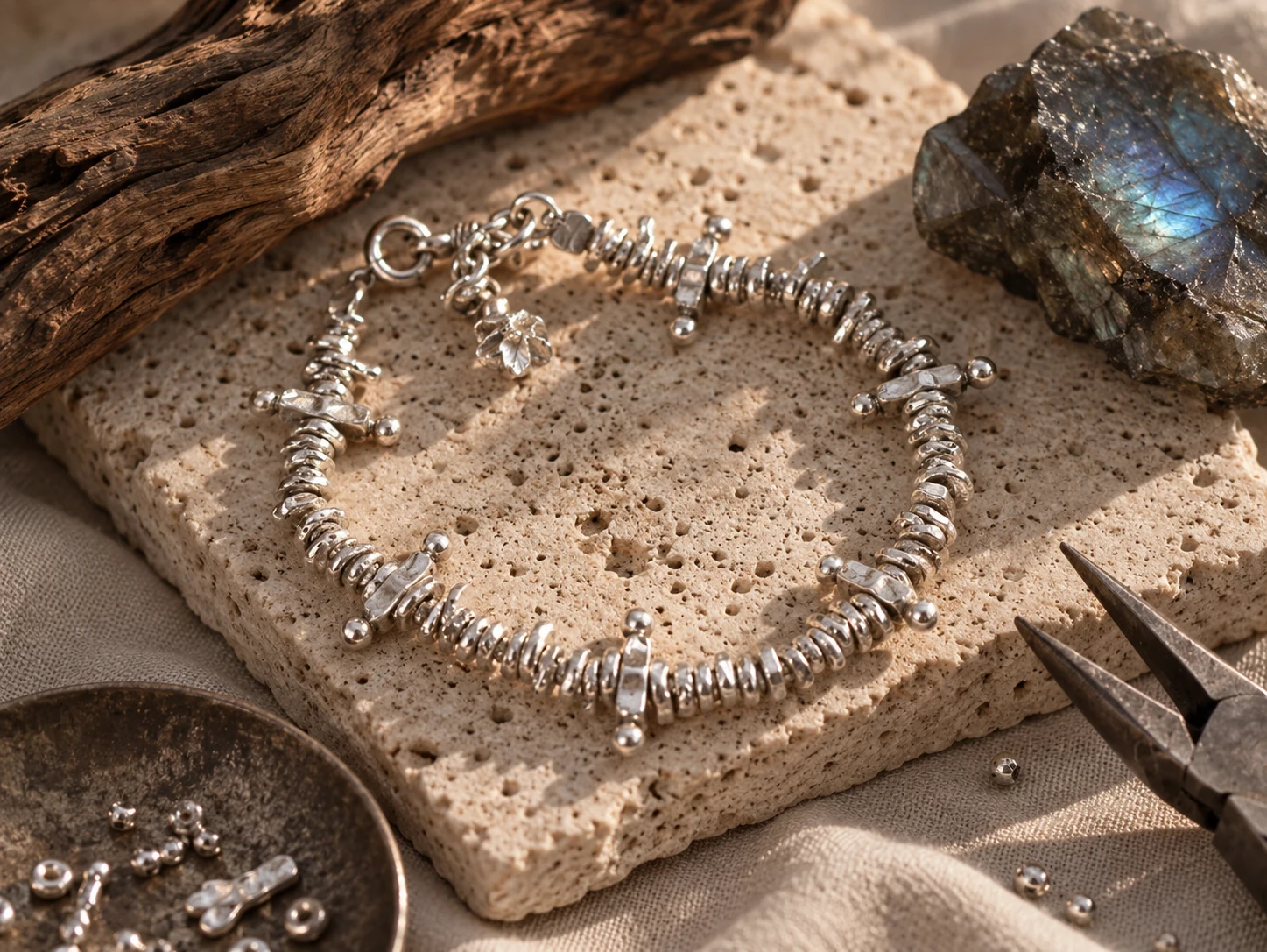
925 sterling silver is an alloy containing 92.5% silver by weight, with the remaining 7.5% made up of other metals — almost always copper. The number 925 is the purity figure, and in most countries it is also a legal hallmark.
That 7.5% is the whole reason sterling silver exists. Pure silver is beautiful and almost useless for jewelry: it is soft enough to bend with your hands and to wear away in a year of daily wear.
Why not just use pure silver?
Fine silver — 99.9% — is wonderfully resistant to tarnishing and takes a deep, soft white colour. It is also roughly as soft as a coin.
| Fine silver (999) | Sterling silver (925) | Silver-plated | |
|---|---|---|---|
| Silver content | 99.9% | 92.5% | A thin surface layer only |
| Hardness | Soft — bends easily | Hard enough for daily wear | Base metal underneath |
| Tarnish resistance | Very good | Good | Poor to fair |
| Longevity | Deforms in wear | Decades with care | Wears through to base metal |
| Typical use | Heirloom, decorative | Jewelry as standard | Costume jewelry |
Sterling is the compromise the industry settled on, and it is a good one. Copper adds hardness and, unavoidably, the tendency to tarnish that copper is known for.
How to tell whether a piece is really sterling
- Look for the hallmark. A genuine sterling piece carries 925, Ster, Sterling or 925/1000 stamped somewhere — usually inside a ring band, on a clasp, or on a small tag near the clasp.
- Check the weight. Sterling feels denser and cooler than plated brass of the same size. This is imprecise, but it is surprisingly reliable once you have held both.
- Look at the wear points. On plated jewelry, high-contact areas like clasp edges and chain links show a different colour as the plating wears through. Sterling wears evenly.
- Be careful with magnets. Silver is not magnetic, so a magnet sticking means it is not silver — but a magnet not sticking proves nothing, since brass and copper are also non-magnetic.
What 925 does and does not guarantee
A hallmark tells you the metal content. It does not tell you:
- How thick the metal is — a very thin sterling band will still deform.
- How well it was made — a poor solder joint fails regardless of purity.
- How the stone was set — a shallow setting can loosen over time.
- That the piece was hand-finished — most jewelry is cast, and that is fine.
In other words, 925 is a starting point, not a quality verdict. It rules out the worst outcomes; it does not guarantee a good one.
Tarnish: the honest version
Sterling silver tarnishes because of the copper in it. Copper reacts with sulphur compounds in air and on skin, forming a dark surface layer. This is chemistry, not a manufacturing fault, and it happens to every sterling piece eventually — including expensive ones.
What varies is how fast. Humidity, air pollution, wool and rubber storage, perfume, sunscreen and household cleaners all accelerate it. A piece kept in a dry box tarnishes far more slowly than one left on a bathroom shelf.
There is a detailed fix in why sterling silver tarnishes, and how to bring it back.
Is 925 the right choice for everyday wear?
For most jewelry, yes. Bracelets, necklaces, earrings and rings in sterling silver are designed to be worn. Two caveats are worth knowing:
- Rings take the most punishment — They meet door handles, desks and keys constantly. A bezel-set stone survives far better than a high prong setting.
- Chains are where thickness matters — A very fine chain in any metal will eventually break. Weight, not purity, determines that.
How we use silver
Our silver work is sterling throughout — no plated components, including clasps and chain. Pieces are shaped, soldered, filed and finished by hand, which is why a finished bracelet carries small irregularities that a casting would not.
We do not polish those out. Hammer marks and softened edges are evidence of handwork, not defects. If you prefer a uniform machine finish, that is a legitimate preference — but it is a different product. See our silver collection for how the finish reads in practice.
925 is a guarantee about what is in the metal. Everything else — thickness, proportion, finish — is craft.