
If a sterling silver piece has gone yellow, then brown, then nearly black, nothing has gone wrong. Silver tarnish is a chemical reaction, not wear. It happens to every piece of sterling eventually, including pieces that cost hundreds.
Understanding the chemistry makes it much less annoying, because almost everything that speeds tarnish up is under your control.
What is actually happening
Sterling silver is 92.5% silver and 7.5% copper. Silver itself is fairly unreactive. Copper is not.
Copper reacts with sulphur compounds in the air — hydrogen sulphide, and the sulphur-bearing pollutants common in cities — to form silver sulphide and copper sulphide. Those compounds are dark. They build up on the surface as a film that first dulls the shine, then yellows it, then darkens it to near-black.
The silver is still there. It is underneath the film. Removing the film restores the piece completely, which is why tarnish is reversible and wear is not.
What makes it happen faster
| Factor | Effect | What to do |
|---|---|---|
| Humidity | Strong accelerator | Store dry; a bathroom is the worst place |
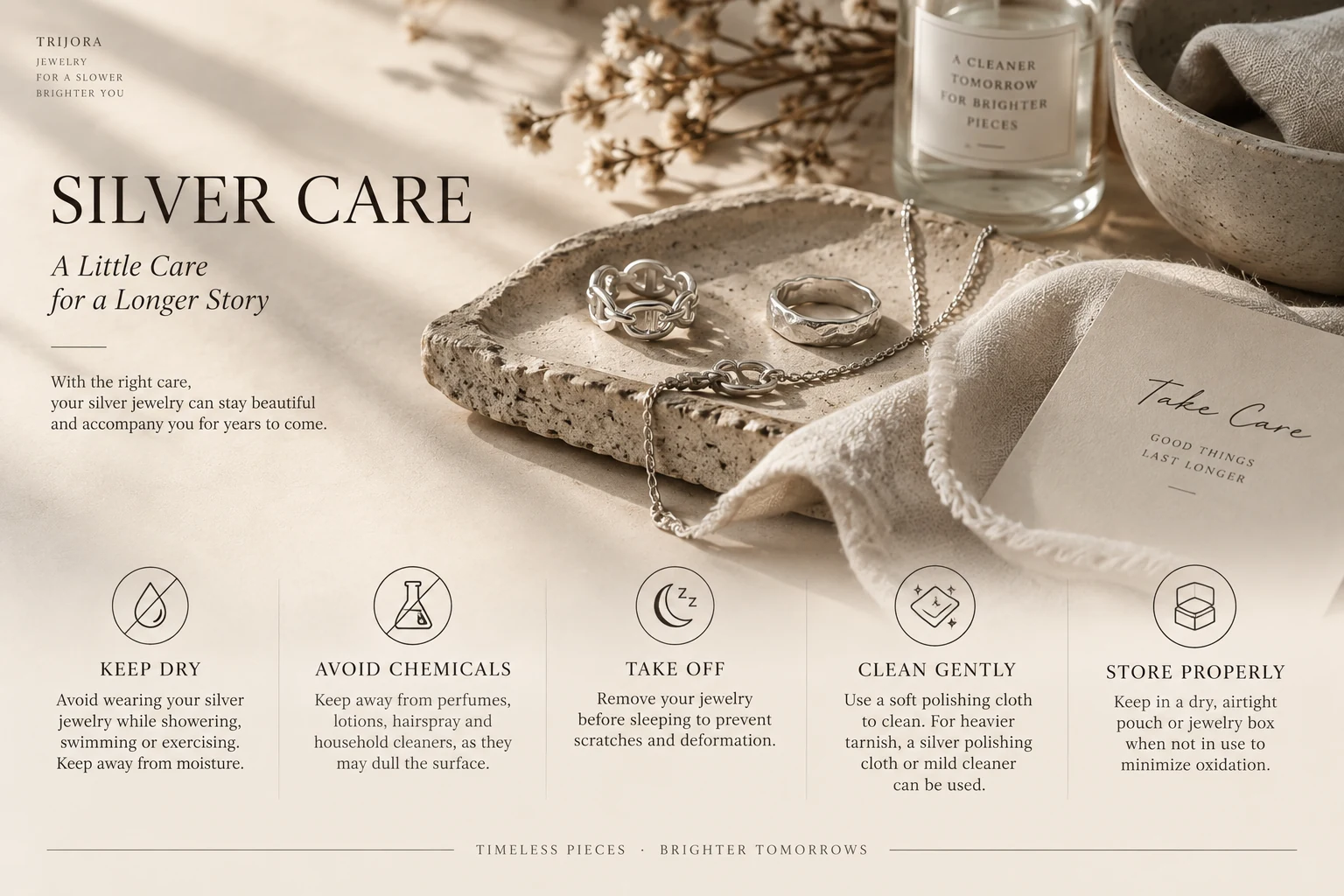
| Air pollution / sulphur | Strong accelerator | Keep in a closed box, not on an open tray |
| Skin pH and sweat | Moderate | Rinse and dry after heavy wear |
| Perfume, sunscreen, hairspray | Strong | Apply first, let dry, then put jewelry on |
| Wool, rubber, latex storage | Moderate — they contain sulphur | Use cotton, flannel or anti-tarnish pouches |
| Chlorine and salt water | Strong | Remove before swimming |
| Household cleaners, bleach | Very strong | Never wear jewelry while cleaning |
| Physical rubbing | Actually protective | Wear helps — friction removes the film as it forms |
That last row surprises people. A silver ring worn daily often tarnishes less than an identical one sitting in a drawer, because constant gentle rubbing keeps the surface clear.
Six safe ways to remove it
- A silver polishing cloth. Impregnated with a very fine abrasive. Best first move for light tarnish, and safe for pieces with stones if you keep it on the metal.
- Warm water, mild soap, soft cloth. Removes surface oils and the earliest film. Dry thoroughly afterwards — leftover moisture accelerates the next round.
- Baking soda paste. A small amount of baking soda with water, applied with a soft cloth and rinsed well. Effective, mildly abrasive, so use sparingly on polished surfaces.
- Aluminium foil and baking soda bath. Line a bowl with foil, add hot water and a spoon of baking soda, and rest the piece in it. The reaction lifts tarnish back onto the foil. Excellent for chains and intricate pieces — but do not use it on anything with pearls, turquoise, lapis or any porous stone.
- A commercial silver dip. Fast, but the harshest option. It strips tarnish aggressively and it will damage porous stones and pearl nacre permanently. Use on bare metal only, and rinse carefully.
- Professional cleaning. For heavy tarnish in intricate pieces, or anything with a stone in a setting you are unsure about.
Tarnish sits on the surface. Wear goes into the metal. One is a cleaning job; the other is a repair.
The one thing never to do
Do not use toothpaste or an abrasive household cleaner. Both remove the polished surface layer of the silver along with the tarnish. You will get a bright piece that has lost its finish and will tarnish faster next time, because the surface is now microscopically rough.
The same applies to steel wool and scouring pads, which leave visible scratches that cannot be polished out by hand.
Pieces with stones need a different approach
This is where most home cleaning goes wrong. The metal and the stone need opposite treatment: metal wants chemical action, stone wants none.
- Labradorite and moonstone — Polishing cloth on the metal only, or warm water with immediate drying. Never dip.
- Turquoise, lapis lazuli, pearl — Dry cloth only. No water, no dip, no ultrasonic. These are porous or soft and will be permanently altered.
- Quartz, amethyst, tourmaline — More tolerant, but still keep chemical dips away from the stone.
There is more detail in how to care for natural stone jewelry.
Preventing it in the first place
- Store pieces separately in a dry, closed box — not on an open tray or in a bathroom.
- Use anti-tarnish pouches or strips. They genuinely work, and cost very little.
- Do not store silver in wool, rubber bands or latex. All contain sulphur.
- Put jewelry on last and take it off first, so perfume and cosmetics never contact it.
- Wipe with a soft cloth before putting it away. A few seconds now saves a polish later.
Does tarnish mean the silver is low quality?
No — and this is the most persistent myth about sterling. The opposite is closer to the truth: fine silver (999) tarnishes less precisely because it contains less copper, and fine silver is a worse material for jewelry because it is too soft.
So a piece that tarnishes quickly may simply be good sterling. What matters is whether the metal is sterling at all, which is a question about the hallmark, not the tarnish. See what 925 sterling silver actually means.