
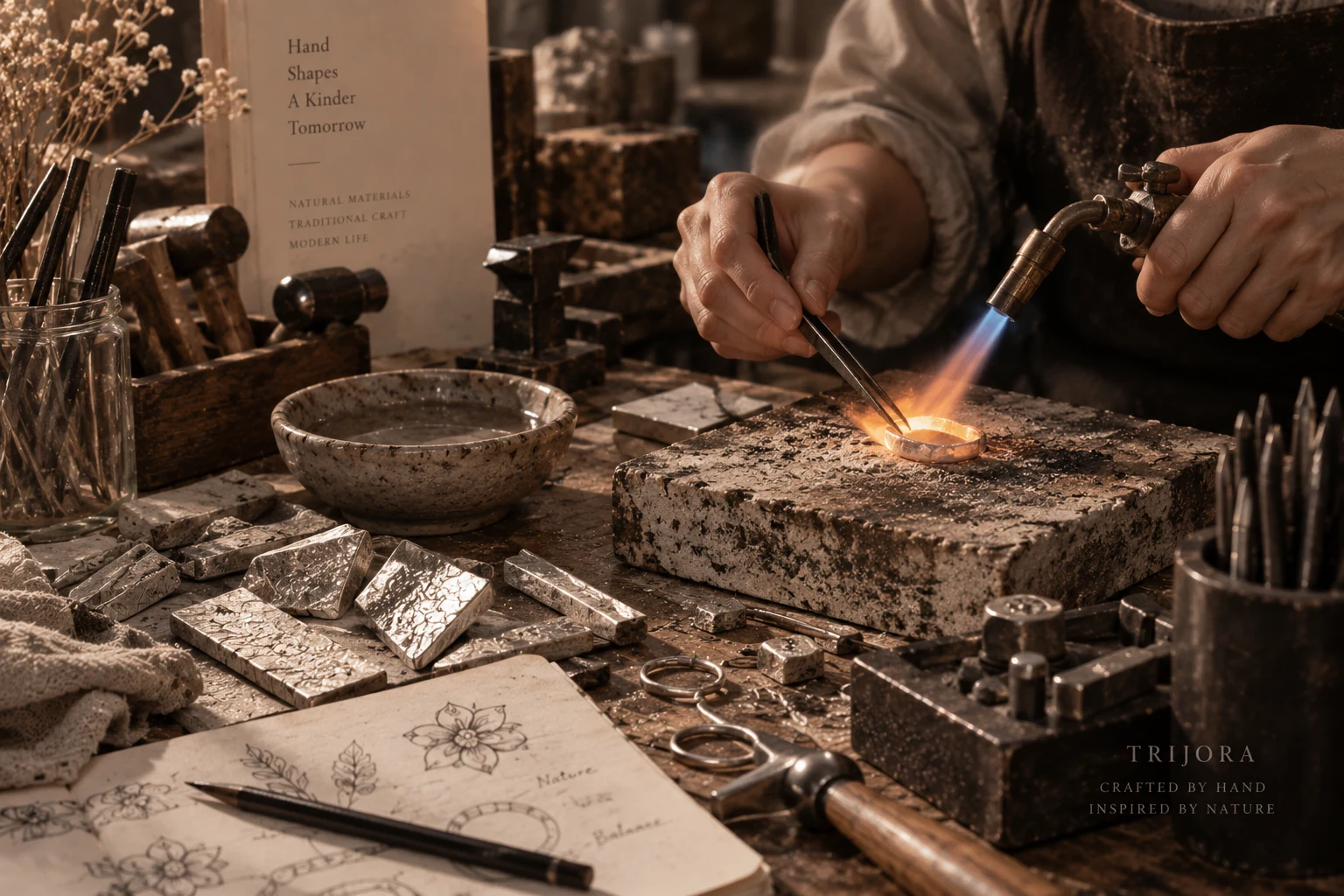
Most jewelry sold as handmade is cast: a mould is filled with molten metal, the piece is cut free, cleaned up and polished. That is a legitimate way to make jewelry, and it produces consistent results. But it is not the same as forming metal by hand.
This is what the second process actually looks like, using a sterling silver bracelet as the example.
1. Starting material
It begins as sheet and wire in sterling silver, bought from a refiner with a certified alloy content. Sheet arrives flat and dead-soft — annealed so it can be cut and shaped without cracking. Wire arrives in coils, in gauges from about 0.6 mm upward.
The first decision is thickness. Too thin and the finished piece will deform in wear; too thick and it will be uncomfortable and unnecessarily expensive. This is why weight matters more than diameter when discussing a bracelet.
2. Cutting and forming
Shapes are marked and cut, then formed. A bracelet band is brought round a mandrel; a sculptural piece is shaped over forms or with hand tools.
The metal will only take so much bending before it work-hardens and becomes brittle. Over-bent silver cracks. So the piece is worked, then annealed with a torch to soften it, then worked again. A complex bracelet may go through this cycle four or five times.
You cannot rush metal. Bend it too far without annealing and it will crack — and the crack will be invisible until the piece is nearly finished.
3. Texturing
Hammer marks, a brushed surface, a soft irregular edge — these are not decoration applied at the end. They are formed into the metal, and they determine how light sits on the finished piece.
Texturing is also the stage where handwork becomes visible. A cast surface is smooth and uniform. A hammered surface reflects light unevenly, which is exactly what makes it read as made rather than manufactured.
We do not polish those marks out. Doing so would remove the evidence of how the piece was made. See our silver collection for how that finish reads in practice.
4. Joining
Where a piece needs to be closed — a chain link, a clasp, a ring band — it is soldered. Silver solder is an alloy with a lower melting point than the piece itself, so the joint flows without melting the work.
Soldering is the most common failure point in jewelry and the hardest stage to hide a mistake. A poor joint looks fine when new and fails in a year. Good practice is a joint that is nearly invisible and fully flowed.
5. Stone selection and setting
For pieces with a stone, this is where the piece stops being generic. The stone is selected individually — for labradorite, for instance, we look for flash that holds through a wide rotation rather than flashing only at one angle.
Setting follows the stone. A regular stone can go into a bezel or a prong setting. An irregular one gets wrapped in wire instead, since a conventional seat cannot hold it. This is the stage where exact colour cannot always be promised in advance.
6. Finishing
Filing removes tool marks and softens edges. Then the piece is polished in stages, from coarse to fine, and finally finished with a polishing cloth. Some pieces are oxidised — a controlled darkening of the recesses to make the form read more clearly.
Finishing is the last ten per cent of the work and roughly a third of the perceived quality. A technically sound piece with a rushed finish looks cheap. It is also the stage most often cut when a maker is under time pressure.
7. Inspection
Before packing: measurements checked against the brief, the setting tested for movement, the clasp operated repeatedly, the finish examined under daylight and under a lamp. Daylight shows the true colour; a lamp shows the scratches.
Why this takes time — and why it costs what it costs
A single handmade bracelet involves several hours of skilled work, most of it not visible in the finished object. There is no way to shorten that without removing stages.
| Stage | Roughly how long | Visible in the finished piece? |
|---|---|---|
| Cutting and forming | 30–60 min | Partly, as proportion |
| Annealing cycles | interleaved | No — but it prevents cracking |
| Texturing | 20–40 min | Yes, directly |
| Soldering and cleanup | 20–30 min | Only if it goes wrong |
| Stone selection and setting | 30–90 min | Yes, centrally |
| Finishing and polishing | 40–90 min | Yes, strongly |
| Inspection | 10 min | No |
What this means when you are buying
- Hand marks are not defects — Irregularity is evidence of forming rather than casting. Uniform perfection usually means a mould.
- Ask what the setting is — A bezel or a wrap protects a stone far better than a high prong setting, especially on a ring.
- Weight matters for durability — More than diameter. A thin band can be wide and still deform.
- Finish is where quality hides — Look at the recesses and the inside of the band. That is where rushed work shows.
- Natural stones cannot be specified exactly — They can be selected for quality. Anyone promising a precise colour is either photographing one stone or setting expectations that will disappoint.