
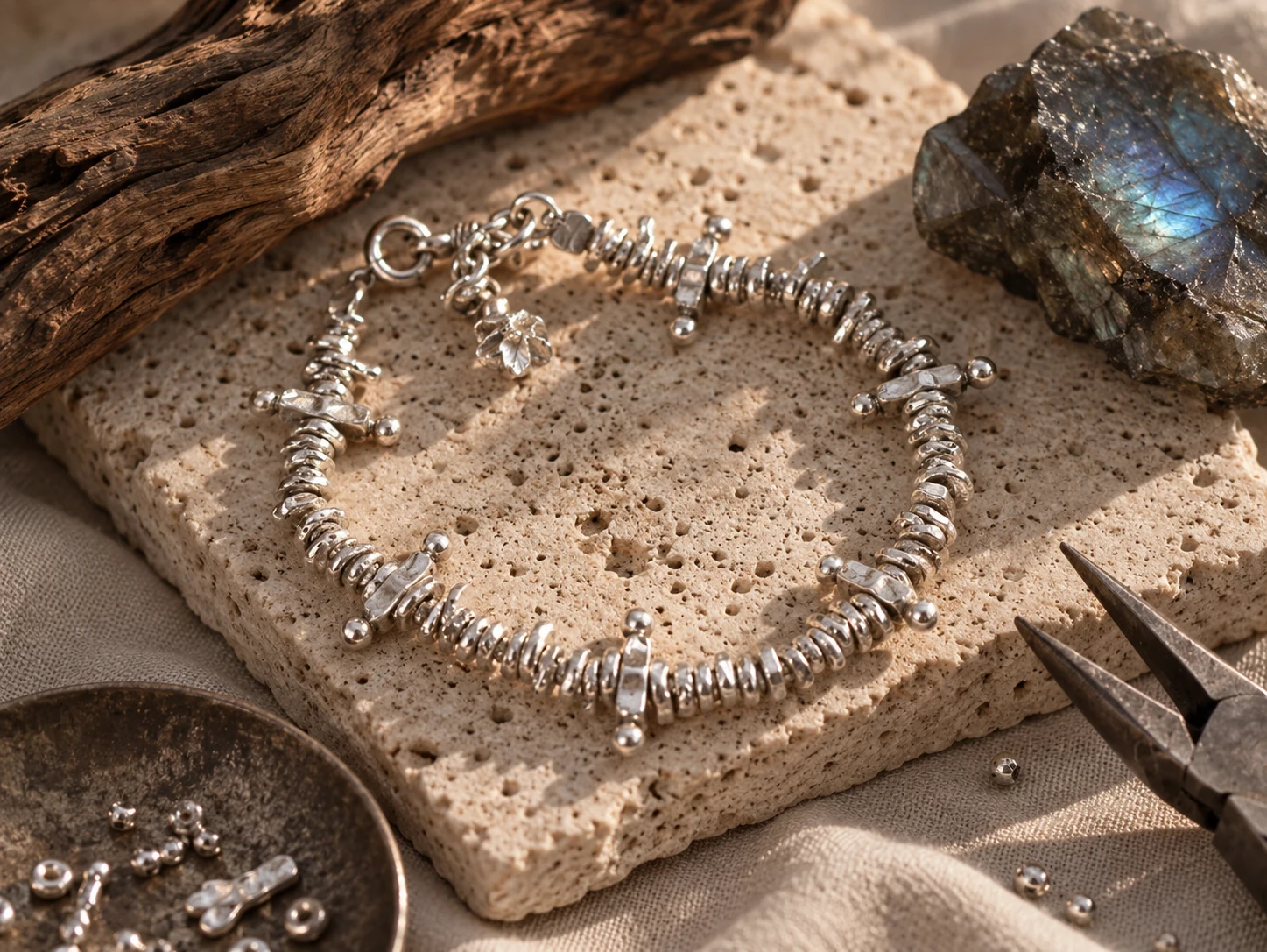
Two pieces can look identical in a photograph and be completely different products. One is silver all the way through. The other is a brass or copper alloy coated with a layer of silver measured in microns. Both can be perfectly good products — but they are not substitutes for each other, and the price difference reflects that.
What sterling silver actually is
925 sterling is 92.5% silver by weight, with the balance usually copper. That 7.5% is not a purity compromise so much as a hardness compromise: pure silver is too soft to hold a shape through daily wear, while sterling survives decades.
The cost of sterling comes from the metal itself. It is priced by weight, it is fully recyclable, and a heavier piece genuinely costs more to make.
What silver-plated actually is
A plated piece is a base metal — usually brass, copper or a steel alloy — with a thin silver layer deposited on the surface. The bulk of the material by weight is not silver at all.
This is not a criticism. Plated jewelry is the right choice for a piece you wear once a season and replace. The mismatch happens when plated pieces are sold as sterling, or when a buyer assumes plated will age the same way.
Side by side
| 925 Sterling | Silver-plated | |
|---|---|---|
| Silver content | 92.5% of the piece | A thin surface layer only |
| Underneath | More silver | Brass, copper or steel |
| Hallmark | 925 / Sterling stamped | None, or base-metal marks |
| Wear behaviour | Wears evenly, may darken | Wears through at contact points |
| Repairability | Can be re-polished and re-finished | Once worn through, it cannot be restored |
| Price logic | Metal weight plus bench time | Base metal plus a plating step |
Five checks you can do yourself
- Find the hallmark. Genuine sterling carries 925, Ster or Sterling stamped inside a band, on a clasp or on a tag. If the listing says only "silver tone" or "silver colour", assume plated.
- Examine the wear points. Clasp edges, chain links, the underside of a ring. Changing colour there is the plating signal.
- Use a magnet. Silver is not magnetic. If a magnet sticks firmly, base metal is exposed.
- Compare weight in the hand. Sterling feels noticeably denser than plated brass of the same dimensions. This is imprecise but it trains quickly.
- Ask what the findings are made of. Clasps, pins and jump rings are where plating shortcuts hide. A sterling chain with plated clasps is a common and misleading combination.
Ask the question before you buy rather than after. Any maker who works in sterling will answer it directly.
Frequently asked
Is silver-plated jewelry bad?
No — it is a legitimate product for fashion use. It is simply a different product. Plated jewelry is a base metal with a thin silver layer, intended to look silver rather than to last like silver.
How long does plated jewelry last?
It depends entirely on wear, sweat, cosmetics and how thin the plating is. High-contact areas — clasp edges, chain links, ring undersides — wear through first, usually within months to a couple of years of daily wear.
How can I test for plating at home?
Look at the wear points rather than the surface. Plated pieces show a different colour where the layer has thinned. A magnet is a quick secondary check: silver is not magnetic, so a magnet that sticks means base metal is exposed.
Does sterling silver tarnish less than silver?
No. Sterling tarnishes because of the copper in the alloy. Fine silver (999) resists tarnish far better, but it is too soft for most jewelry. Sterling is the standard compromise.