
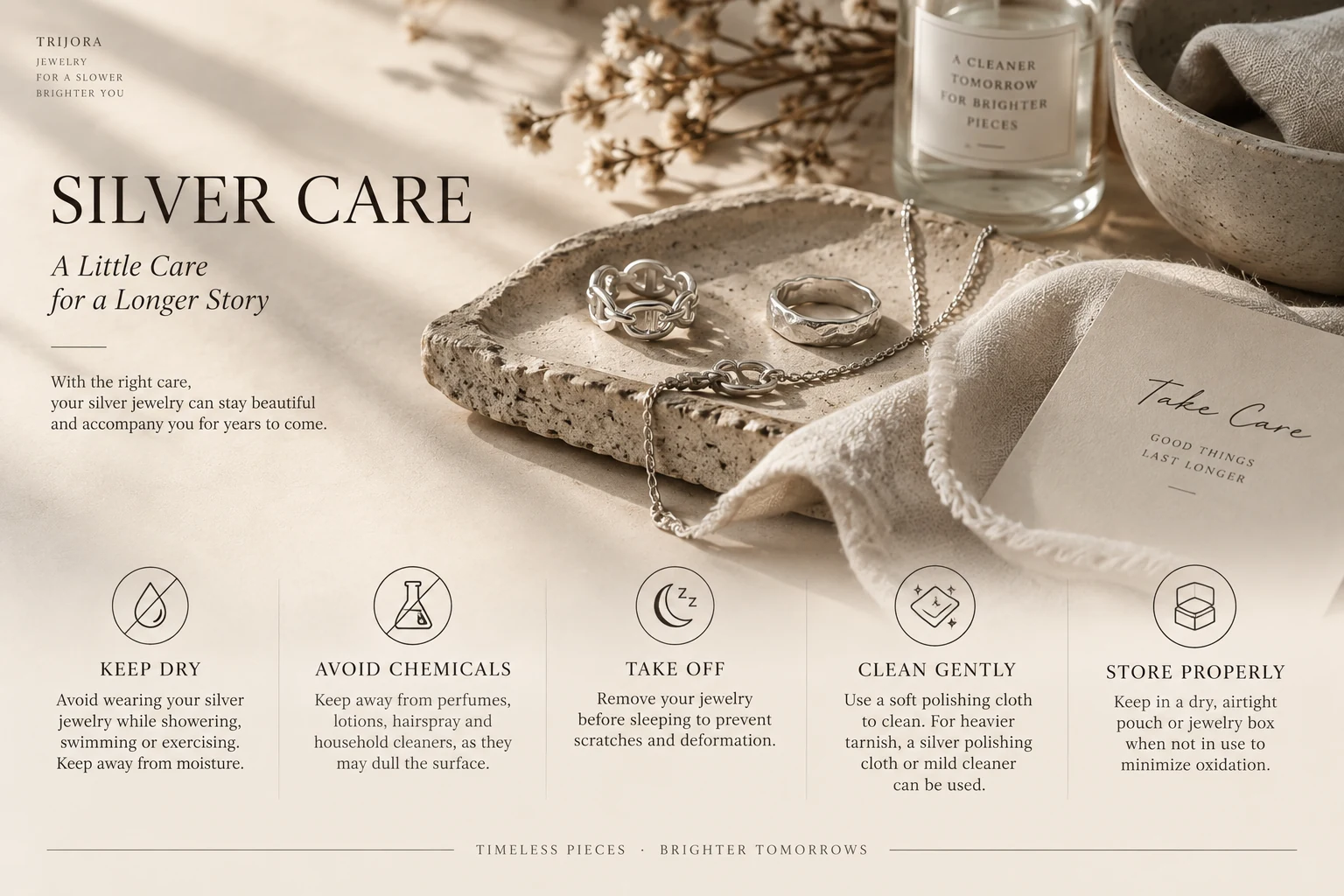
Almost everyone who owns sterling silver asks the same question eventually: why has it gone dark? The answer is chemistry, and once you understand it, tarnish stops being alarming and becomes a maintenance task.
What is actually happening
Sterling silver is 92.5% silver and 7.5% copper — usually copper, because it is what makes the alloy hard enough to wear. That copper reacts with trace sulphur compounds in the air, producing a layer of silver sulphide on the surface. It is grey-black, it forms fastest in damp conditions, and it does not damage the metal underneath.
The reason sterling tarnishes and fine silver (999) does not, is that fine silver has almost no copper to react.
What makes it happen faster
- Sulphur sources: rubber bands, felt, newspaper print, egg cartons, some wool fabrics, matches.
- Moisture and warmth: a bathroom shelf is close to the worst storage environment there is.
- Body contact: sweat, salt, and residues from perfume, hair spray and cosmetics accelerate tarnish noticeably.
- Sulphur-heavy water: some hard water and hot-spring water will darken silver quickly.
What does not cause it
Wearing a piece regularly usually makes it tarnish slower, not faster — oils from skin form a partial protective layer. The pieces that go dark fastest are the ones that sit untouched in a drawer or live in a damp bathroom.
How to clean it
Light tarnish
A silver polishing cloth. Work with short, firm strokes until the shine comes back, then wash the piece with mild dish soap and cool water, and dry it completely. This is the method to use on pieces with fine chased or textured detail, because it is gentle.
Heavy tarnish
- Check that the piece is solid sterling. Silver dip solutions will strip plating and can damage non-silver findings.
- Submerge for the shortest effective time — usually a few seconds. Check every second or two.
- Rinse thoroughly under cool running water immediately.
- Dry fully with a soft cloth, then polish lightly with a clean cloth.
Dip is faster and more aggressive. It suits plain, smooth pieces. It is not the right choice for chains with small findings, or for anything with stones set in it — the solution can reach the setting.
What to avoid
- Toothpaste — mildly abrasive and can leave a dull residue.
- Silver electro-polish — strips plating and can over-brighten a hand-finished surface.
- Any dip solution on pieces with pearls, turquoise or other porous stones.
- Leaving pieces in the dip bath "a bit longer" — it works fast and keeps working.
Storing silver properly
Store each piece separately, in an airtight bag if possible, away from rubber and wool. Keep it out of the bathroom. A little make-up sachet or a silica packet in the drawer does more than any tarnish-free cloth.
And put the pieces on. A silver bracelet that is worn every week stays cleaner than one that sits in a box for a year.
Frequently asked
Why does my silver jewelry turn dark?
Sterling silver contains copper, and copper reacts with sulphur compounds in the air to form a dark layer. This is called tarnish and it is a normal chemical reaction, not a sign of poor quality.
Why does one piece tarnish faster than another?
Skin chemistry, storage conditions and what the piece touches all matter. Pieces worn on the same person can tarnish at different rates depending on sweat, cosmetics and even medication.
How do I clean tarnished silver at home?
Use a silver polishing cloth for light tarnish, worked with short firm strokes. For heavier tarnish, a silver dip solution for no more than a few seconds, then rinse under cool water and dry immediately.
Will polishing damage my silver?
Polishing removes a microscopic amount of metal each time. Occasional polishing is fine and normal. Frequent aggressive polishing will gradually round off fine details and soften the surface.